
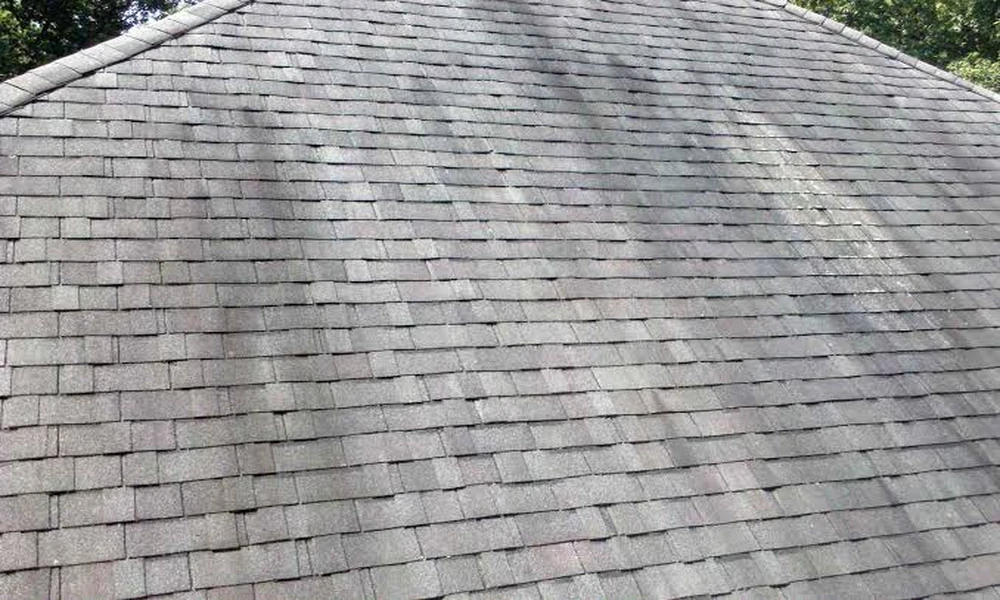
Stand at the end of your driveway on a clear morning and look at the north side of your roof. If it has gone dark in long, ragged stripes, you are in good company, and you may also be wondering whether the whole thing has to be replaced. People who search for Peace Keepers Roofing are often asking exactly that, and the honest answer from Tim Davis, the veteran who founded the business, tends to start smaller. Alongside lawn care, pruning and gutter work, his team soft washes roofs with a light solution instead of blasting them, and covers delicate plants beside the house when the situation calls for it. Before anyone spends serious money on new shingles, it helps to understand what is actually sitting up there.
The stripes are a living thing
Those dark streaks are rarely dirt, soot or mildew, even though they look like all three. In most cases they are an airborne algae called Gloeocapsa magma, and it feeds on the limestone filler packed into many modern asphalt shingles. Rain carries it downhill, which is why the marks fall in neat vertical lines. Shade and moisture are what let it settle in. That is why the north slope, or any section tucked under a tree, goes dark first while the sunny side stays clean. The algae itself does not eat through a shingle overnight, but it does hold moisture against the surface and warm up under the sun, and that invites trouble you would rather not have. Manufacturer guidance points out that almost every type of roofing can be affected, so a streaky roof says more about the climate and the shade than about the quality of the install.
Moss plays by different rules
If the stripes are green and fuzzy rather than black, you are probably looking at moss, and that deserves more respect. Moss sends tiny root like threads down between the shingle layers. Over a few seasons those threads can lift the edges, break the seal that keeps wind from getting underneath, and leave little pockets that hold water for days.
Lichen is the stubborn cousin, those flat crusty patches that seem painted on. Neither one should be scraped off dry. Pulling at a mat of dry moss tears granules away with it, and those granules are the part of the shingle that shields it from sunlight. The better approach is patience. A cleaning solution needs time to soak in and do its work, and the dead growth then loosens and rinses away.
Why the pressure washer belongs in the garage
Plenty of homeowners reach for a pressure washer because it works so well on a driveway. A roof is a different animal. The surface of an asphalt shingle is a layer of mineral granules held in place by asphalt, and a hard jet of water knocks them loose. Strip enough of them and the shingle ages years in an afternoon, and aggressive washing can put a warranty at risk. University extension specialists advise against high pressure on shingles for the same reason.
Soft washing flips the idea around. The pressure stays close to what a garden hose delivers, and the solution does the real work, breaking down algae and moss at the source.
What a careful wash looks like from start to finish
The details change from house to house, but a sensible roof wash tends to follow this order.
- Look at the roof and the surroundings first, noting the pitch, the material and how heavy the growth is.
- Wet down and, where needed, cover the plants and shrubs near the walls so nothing gets scorched.
- Apply the solution at low pressure, working from the lower areas of the roof to the upper ones in an even pattern.
- Leave it to dwell. This waiting stage is where the cleaning actually happens.
- Rinse gently so the dissolved residue leaves the roof without scouring it.
- Flush the gutters and downspouts so none of that runoff settles in them.
Good roof cleaning is mostly chemistry and timing, with very little muscle.
Timing is half the job
A wash done at the wrong moment can fail even when everything else is right. On a scorching afternoon the shingles heat up so much that the solution dries before it has done any good. A cool, overcast day is ideal, since the mix stays wet long enough to work. Windy days are a poor choice too, because spray drifts onto plants.
Do not be alarmed if the roof does not look perfect the moment the crew leaves. The streaks often keep fading over the following days, and a good rain helps finish the rinse.
Your gutters have been watching all of this
Roof growth and gutters are more connected than most people realise. As algae and moss die back and shingles shed a few granules, that material ends up in the gutters, where it mixes with leaves and seeds and packs into a heavy sludge. Water that cannot flow through the gutters spills over the edge, soaks the fascia and splashes onto the foundation. That is why roof cleaning and gutter cleaning make sense as a pair.
Signs the problem is bigger than a stain
A wash can take care of growth, but it cannot repair a roof that has genuinely worn out. Cleaning a dead roof just gives you a cleaner dead roof, so it is worth looking for the signs that point to something deeper.
- Shingles that curl at the corners or cup in the middle
- Bald patches where the granules have worn away, often with a smooth black surface showing
- Piles of grit collecting at the bottom of your downspouts
- Cracked or missing shingles after a storm
- Brown water marks on a ceiling or daylight showing in the attic
If you spot any of these, ask a qualified roofer to inspect before you pay for a cleaning. Cosmetic work should never be laid over a failing surface.
Keeping the streaks from coming back
Algae spores are everywhere, so no wash is permanent, but there are ways to slow things down. Trimming overhanging branches lets sunshine and airflow dry the roof faster, which takes away the damp conditions that algae love. Strips of zinc or copper fitted near the ridge release tiny amounts of metal with every rain, and that makes the shingles below a lot less appealing. When the day finally comes to replace the roof, algae resistant shingles are worth asking about, since they are made with that problem in mind.
So the next time you notice the north side of your roof looking tired, resist the urge to panic or to grab a pressure washer. Streaks are a sign of damp, shady conditions far more often than a sign of a dying roof, and a gentle, well timed wash can give you years of life and curb appeal back. Look closely, rule out real damage, and treat the roof the way you would treat anything you hope to keep for decades.

Comments are closed.