
A door that opens twice a day and a door that opens twice a minute are not the same purchase, even when they fill the same size opening. Commercial door selection comes down to traffic, temperature and what sits on the other side of the threshold, whether that is a trailer, a freezer aisle or a parking lot. For a working facility, price per cycle tells you more than price per door.
That math gets sharper in the Mid-South. Memphis summers bring long stretches of heat and humidity, winters bring the occasional hard freeze, and spring storms push hard on every wind-loaded panel. The metro is also one of the busiest freight markets in the country, built around the FedEx World Hub at Memphis International Airport, several rail yards and a wide ring of distribution space reaching into North Mississippi. Doors here tend to work harder than average, and so do the dock plates in front of them.
Buyers comparing commercial garage doors in Memphis can lean on A-1 Door Co., a family-owned dealer out of Munford that has supplied and installed commercial doors for warehouses, shops and loading docks since 1994. The team handles Commercial Garage Doors from measurement through final testing, and it supplies Commercial Dock Plates matched to the trailers and equipment that actually cross them. Send over your opening sizes and a rough daily cycle count with a quote request, and they can suggest a door and plate combination that fits the way your building runs.
The Three Doors at a Glance
| Door type | Best-fit use | Main trade-off |
|---|---|---|
| Insulated sectional | Truck docks and conditioned warehouses with ceiling room for tracks | Needs headroom and side room; panels dent under forklift impact |
| Rolling steel | Tight headroom, high security, storefronts, service bays | Lower insulation and more air leakage than a well-sealed sectional |
| High-speed | Freezer and cooler openings, busy interior traffic lanes | Highest upfront cost and more complex controls to maintain |
How They Compare Where It Costs Money
Insulation. Insulated sectional doors usually lead here, since foam-filled steel panels and tight section joints hold conditioned air better than coiled slats. Insulated rolling steel closes some of the gap but rarely matches a good sectional. The door industry’s trade association recommends in itstechnical data sheet on environmental considerations for exterior doors that R-value and U-factor be determined by standardized testing, so ask for tested numbers rather than marketing figures.
Air sealing. Insulation only helps if the door seals. A study summary from the National Institute of Standards and Technology notes a Department of Energy estimate that air leakage through building envelopes made up about 6 percent of the energy commercial buildings used. On a Memphis dock, that leakage is humid air your HVAC has to dry and cool. High-speed doors fight this differently, by cutting the time the opening stays open at all.
Security. Rolling steel wins. Interlocking slats, steel guides and a coil tucked overhead make it the standard choice for storefronts, pharmacies and after-hours service bays. Sectional steel doors are solid but offer more panel surface to pry. Fabric high-speed doors are built for traffic flow, not break-in resistance, and often sit behind a secondary security door.
Cycle life. Commercial door systems are commonly specified at tiers like 10,000, 25,000, 50,000 or 100,000 cycles, and the rating mostly depends on spring and drive design. A cross-dock door that cycles 80 times a shift will chew through a base spring package fast, so busy docks should specify high-cycle springs from day one. High-speed doors are engineered for constant cycling and often skip torsion springs entirely.
Speed. High-speed doors are defined by a minimum average opening rate, which is the whole point. Sectional and rolling doors move at ordinary operator speeds, which is fine for a door that opens when a trailer backs in and stays open through loading.
Upkeep. Sectionals need track alignment, roller and hinge service, and spring balancing. Rolling doors need guide cleaning, slat inspection and barrel lubrication. High-speed doors trade springs for motors, sensors and controllers, which means fewer mechanical wear parts but a service technician who understands drives and photo eyes.
Where the Dock Changes the Choice
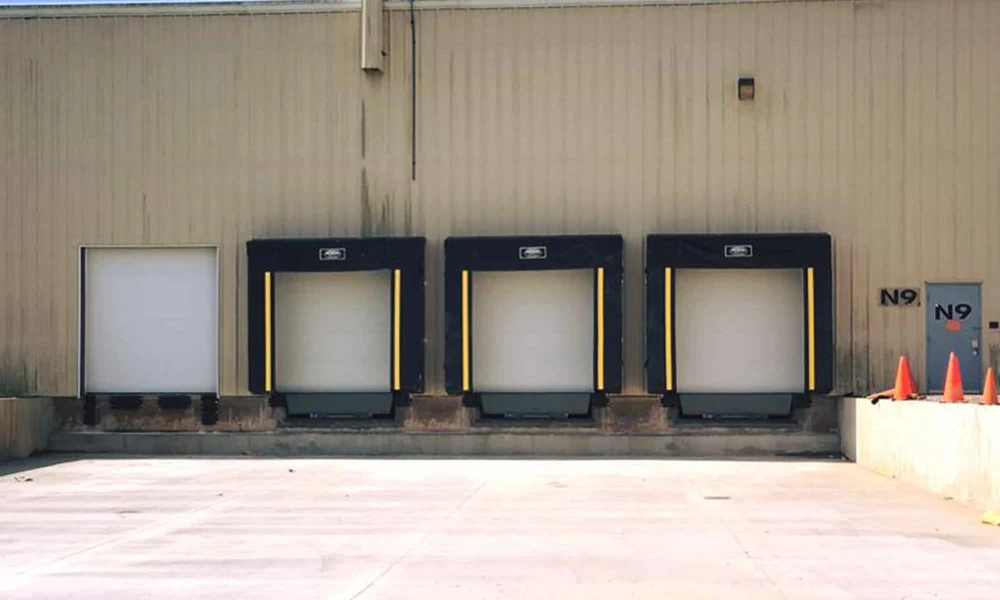
Sectional at the trailer face. Most truck docks use insulated sectional doors because they seal well against dock seals or shelters and close down onto the dock leveler or plate area. They pair naturally with portable dock plates on lower-volume docks where trailer heights stay fairly consistent.
Rolling steel at the dock. When the building has low clearance above the opening or ductwork in the way, rolling steel fits where tracks will not. The trade-off is weaker sealing, so the dock seal and the bottom astragal do more of the work.
High-speed behind the dock. In cold chain buildings, a fast door often sits between the dock and the freezer or cooler, keeping cold rooms closed while forklifts shuttle pallets. The exterior dock door can stay sectional.
The plate itself. Whatever door you choose, the plate in front of it carries the forklift. The OSHA warehousing safety page lists loading docks among the main hazard areas in warehouse work, alongside forklifts and material handling. A plate rated below the real load of a loaded forklift, or one that shifts during use, undoes a good door choice.
Matching the Door to the Building
Air cargo and cross-dock operations. Constant trailer turns favor insulated sectionals with high-cycle springs at each dock position, backed by plates sized to the heaviest equipment on the floor.
Cold storage and food distribution. Insulated sectionals on the trailer side and high-speed doors on interior temperature boundaries give the best balance between energy and throughput.
Manufacturing and general warehousing. Plants with cranes, sprinklers or low steel above openings often end up with rolling steel, especially on doors that open only a few times per shift.
Service bays, retail and storage. Rolling steel suits openings that sit closed most of the day and need to be locked tight overnight.
The right answer is often a mix rather than one door type across the whole building. Map how many times each opening actually cycles, what temperature sits on each side of it, and what rolls across its threshold. With those three numbers on paper, the choice between sealing, security and speed usually makes itself, and the dock plate can be sized to match instead of being an afterthought.

Comments are closed.